
 8/10
Mutant Year Zero: Road to Eden for RPG fans
Lead a party of mutants, a duck with a crossbow among them, across a post-human Earth where nature has swallowed the cities. Scout in real time, then break into turn-based combat with ambushes you set yourself, and unlock new mutations as you hunt the legend of Eden. Dark and atmospheric, with jokes that land.
A party-based tactics RPG: you scout a ruined world in real time, set up an ambush, then fight it out turn by turn while a written story and the mutant companions' banter keep the bleak setting light. The atmosphere and exploration carry the game, and destructible environments give each encounter a plan to build. Character progression stays thin, with only a few ability choices per character, so you lean on stealth and positioning for your tactical variety. It's a compact, characterful adventure for RPG fans who want their strategy wrapped in story and personality, and it delivers exactly that with confidence.
- Single-player
- 1 player
- Windows


What’s good
- The atmosphere and visuals are beautiful and immersive
- The writing and humor are entertaining and charming
- The turn-based combat is satisfying and tactical
- Stealth mechanics allow for creative ambushes
- The destructible environment adds strategic depth
- The mutant characters have distinct personalities
- Exploration feels rewarding with plenty of loot
What’s not
- Stealth is mandatory and going loud often leads to defeat
- Combat can become repetitive by picking off stragglers
- Character progression and ability choices feel limited
- The game is short with a cliffhanger ending
- Difficulty spikes early and can be punishing on higher settings
- Some UI bugs and control issues occur
- Lack of a minimap makes exploration tedious
- Healing is limited outside of combat
A post-human Earth reclaimed by nature
A wrecked climate, economies in collapse, a plague that killed on a massive scale and old superpowers squaring off against new ones had already hollowed things out. Then atomic bombs were actually used in a war, the first time since 1945, and the sky burned in waves from one horizon to the other before the fallout drifted down. Now the Earth is still. Nature has invaded ruined cities, and wind sweeps through empty streets that have become graveyards.
The humans are all gone. Left to pick over what civilization abandoned are the Mutants, twisted humanoids and animals both, hunting for some kind of salvation or just their next meal. You lead a team of them: Dux, Bormin, Selma and others, each with a personality and a bent, peculiar way of seeing themselves and the mess they live in. The game comes from a studio that includes former HITMAN and PAYDAY designers, and it pairs turn-based combat in the vein of XCOM with real-time sneaking and wandering, so you creep across a world reclaimed by nature and by Mutants while you work out what's still worth wanting out of it.

Sneak into position, then fight it out
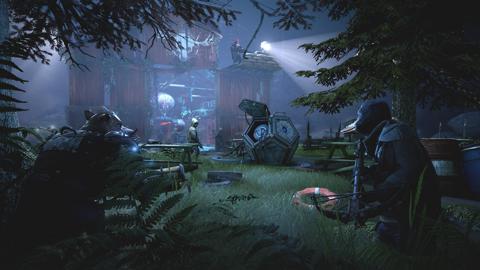
You move through an enemy camp in real time, with no turn order holding you back, placing each Mutant where you want the fight to start. Stay out of floodlights, break line of sight, and drop a guard quietly with silenced weapons so the rest of the camp never learns you were there. Then the fighting begins, and play shifts into a turn-based tactical system in the style of XCOM, a slow, deliberate puzzle where one careless move can wipe out your squad.
When quiet isn't working, go the other way: destructible walls and buildings can be blasted open to carve out a new angle on the fight. Dux is the strangest tool you have for this, a four-foot duck who talks and carries a crossbow, and who can still slip into a packed camp without anyone clocking him. Mutations widen your options as you go, with Selma throwing out grasping vines and Bormin using Charge to slam into a line. Sneaking sets the ambush, and the tactics decide everything that follows.

Scavenge, restock, and suit up
Everything you carry comes out of the ruins: metal scrap, weapon parts and medkits pulled from places people abandoned a long time ago. Spend them at the Ark, a neon-lit haven full of dubious characters, where you restock supplies and plan the next run out. The kit you assemble from those runs gets strange: makeshift slingshots sit beside high-powered rifles, top hats beside police vests, all of it picked to keep your Mutants alive a little longer.
Loot decides how much trouble you can handle, so the urge to poke through one more ruin is real, even when you should be heading back. The clearest picture of the post-human condition is a boar, mutated and plated in spiked metal, closing on you with a blunderbuss. That's the world you're equipping for, and the reason to keep combing the ruins before you push further out.
Questions readers ask about this mutant tactics game?
What kind of combat does the game use?
Fights run on a turn-based tactical system in the style of XCOM: you position your Mutants, spend actions carefully, and read the field before committing. One careless move can wipe out your squad. The combat rewards patience and planning over speed, and the destructible environment gives you extra angles to exploit while the writing and humor keep the mood light.
How do stealth and exploration work together?
Stealth happens in real time, before any turn order kicks in. You sneak into an enemy camp, place your team where you want the fight to begin, and either avoid conflict entirely or catch guards unaware for an ambush. Picking over the ruins you cross in search of loot feeds directly into that: the more you explore, the better equipped you're when stealth runs out. Stealth leans on being mandatory at times, since going loud often ends in defeat.
Who are the main characters?
You lead Dux, Bormin, Selma and other Mutants, each with a distinct personality and their own skewed view of the world. Dux is a duck with a crossbow who can sneak into a crowded camp unnoticed. Bormin is a boar with a temper who can Charge into a line, while Selma can throw out grasping vines. Each one unlocks their own mutations and abilities as you go.
Is the game difficult for beginners?
It can be. Difficulty spikes early, and the higher settings get punishing quickly. Starting on a gentler setting gives you room to learn the systems. The core loop is straightforward to grasp, but the combat rewards careful positioning and punishes careless moves, and healing outside of fights is limited. The exploration and humor ease you in, while the tactical demands ask more of you as the fights tighten up.


